

Andrés Saura Pérez. Graduado en Gestión Logística y estudiante del Máster Profesional de Analista Internacional y Geopolítico en LISA Institute. Cuento con experiencia profesional en la OTAN en áreas de logística operativa y gestión presupuestaria. Mis áreas de interés incluyen la seguridad europea, la cooperación EU-OTAN, la logística internacional, la gestión de cadenas de suministro y el análisis de datos aplicado a la toma de decisiones.
Abstract
The evolving European security landscape (marked by Russia’s war against Ukraine, intensifying great power competition, hybrid threats, and growing instability along Europe’s periphery) has reinforced the centrality of cooperation between the European Union and NATO (NATO 2022; European Commission, 2023). As both institutions adapt to a more contested volatile strategic environment, questions surrounding burden-sharing, strategic autonomy, capability development, and political cohesion have become increasingly marked (Meyer and Schmidt, 2021).
This paper argues that EU-NATO cooperation is no longer a complimentary option but a structural necessity for European security. While NATO remains the cornerstone of collective defense, the EU has expanded its role in resilience, sanctions policy, defense industrial coordination, cyber security, and hybrid threat mitigation (European Commission, 2023; EEAS, 2023). The challenge for 2026 and beyond lies not in choosing between strategic autonomy and transatlantic unity, but in operationalizing a model of structured independence that enhances deterrence while reducing duplication and fragmentation (Biscop, 2020).
The analysis identifies three priority areas for strengthened cooperation:
1. Defense capability development and industrial coordination particularly considering the EU’s emerging defense instruments (European Defence Agency, 2023).
2. Countering hybrid and cyber threats through integrated civil-military frameworks (EEAS, 2023; NATO, 2023).
3. Reinforcing political cohesion obstacles that continue to constrain deeper integration (Meyer and Schmidt, 2021).
Policy recommendations focus on improving interoperability, institutionalizing joint strategic planning, expanding coordinated resilience mechanisms, and clarifying the division of labor in crisis response scenarios. By proposing pragmatic steps toward functional integration rather than institutional merger, this paper outlines a realistic pathway to strengthening Europe’s collective defense posture while preserving transatlantic cohesion.
In an era defined by systematic rivalry and multidimensional threats, the credibility of European security will depend on whether the EU and NATO can move from coordination to true strategic consideration.
Introduction
Russia’s full-scale invasion of Ukraine marked a structural turning point in European security, reaffirming the centrality of the North Atlantic Treaty Organization while accelerating the geopolitical role of the European Union (NATO, 2022; European commission, 2023; Fiott, 2022). Alongside conventional warfare, the conflict has highlighted the increasing relevance of hybrid threats, including cyberattacks, disinformation campaigns, and critical infrastructure sabotage. These developments reflect a broader shift toward systematic rivalry and multidimensional security challenge. (Bunde et al., 2023).
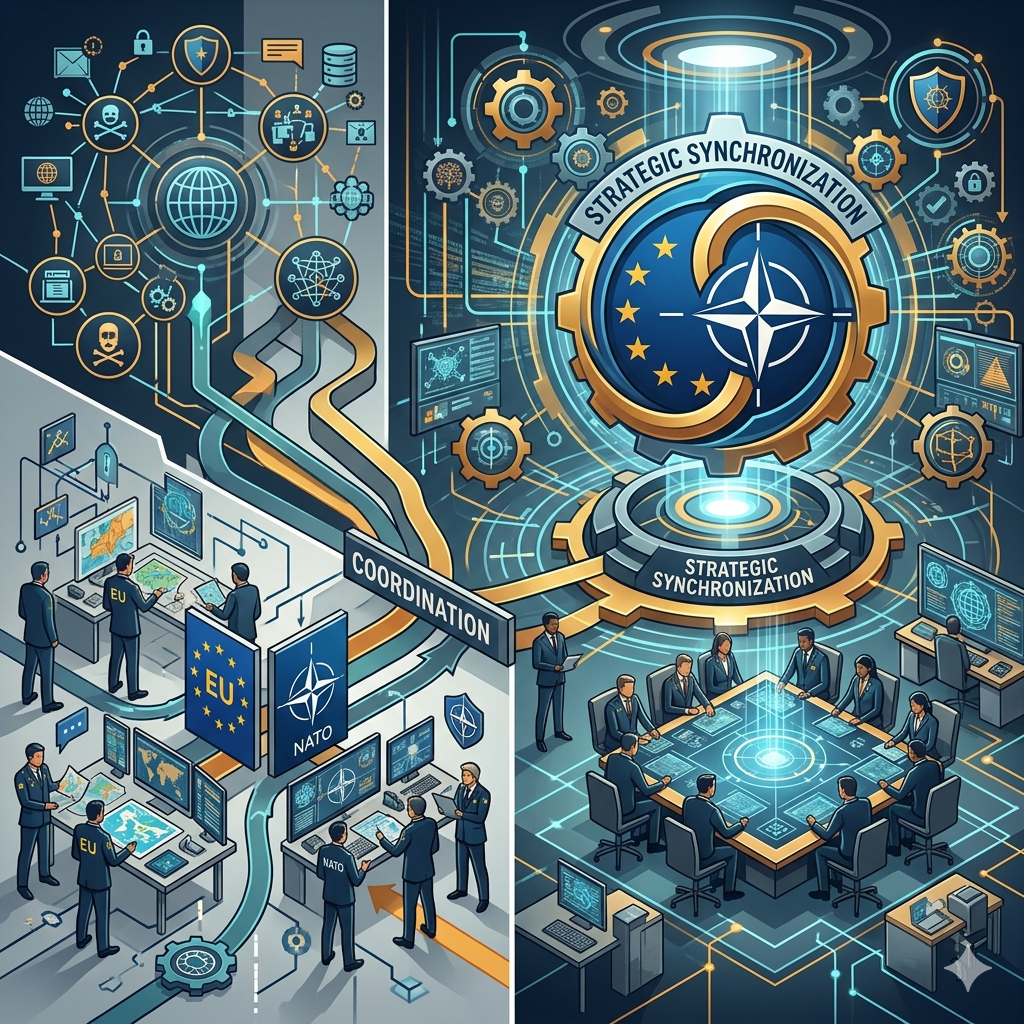
Despite repeated commitments under the 2016 and 2023 Joint declarations, EU-NATO cooperation remains largely coordination based rather than strategically integrated. This paper argues that core challenge is not institutional rivalry, but the absence of structured mechanisms to integrate civil and military responses to hybrid threats. Moving beyond coordination requires what this paper defines as strategic synchronization: the systematic alignment of threat assessment, operational planning, and response tools across institutional boundaries.
Focusing on hybrid and cyber threats, this paper identifies the primary structural obstacle to effective EU-NATO cooperation and proposes a concrete way to overcome it.
Hybrid threats and institutional complementary
Hybrid threats deliberately reduce the differentiation between war and peace, targeting both military and civilian domains. They include cyber operations, disinformation, economic coercion, and attacks on critical infrastructure. As Rid (2020) argues, modern political warfare is designed to exploit ambiguity and institutional fragmentation rather than rely solely on conventional force.
NATO is structured for collective defence and military deterrence. Its strengths lie in intelligence-sharing among allies, cyber defence capabilities, and operational planning (NATO, 2022). However, NATO has limited authority over civilian sectors such as energy, digital regulation, and internal security.
Conversely the European Union possesses extensive regulatory and economic tools. Through sanctions, digital governance, and resilience frameworks such as the EU Hybrid Toolbox, it can address vulnerabilities in critical infrastructure and societal resilience (EEAS, 2023; European Commission, 2023). Yet the EU lacks the military capabilities required for deterrence and rapid response.
This division of labour suggests a high degree of complementary. In theory, NATO provides military backbone of deterrence, while the EU reinforces resilience across civilian sectors. In practice, however, this complementary remains underutilized, as highlighted by recent assessments of EU-NATO cooperation (European Parliament, 2023).
The structural obstacle: Fragmented civil-military cooperation
The primary reason EU-NATO cooperation has fallen short of its ambition is not political disagreement, but fragmented civil-military cooperation.
First, institutional separation limits joint planning. NATO and the EU operate under distinct legal mandates, decision-making procedures, and information-sharing frameworks. While both organizations conduct threat assessments, these are fully integrated or jointly operationalized (Smith, 2018).
Second, asymmetry in competencies creates coordination gaps. Hybrid threats often originate in civilian domains (cyberattacks or infrastructure are a clear example of it) but can escalate into security crises requiring military involvement. The absence of predefined escalation pathways between EU and NATO mechanism delays response and reduce effectiveness.
Third, political sensitivities continue to constrain deeper cooperation. Concerns over sovereignty, strategic autonomy, and institutional overlap have encouraged cautious, incremental collaboration rather than systematic integration (Meyer and Schmidt, 2021; Howorth, 2014).
As a result, existing cooperation mechanisms (despite the 2016, 2018 and 2023 Joint declarations) remain largely reactive, informal, and insufficient institutionalized.
From coordination to strategic synchronization
To address these limitations, EU-NATO cooperation must evolve from coordination to strategic synchronization.
In operational terms, strategic synchronization entails:
- Joint threat assessment: producing shared, real-time analysis of hybrid threats.
- Integrated planning: Aligning EU civilian instruments with NATO operational scenarios.
- Coordinated response protocols: Establishing predefined mechanisms for escalation and crisis management.
This approach differs fundamentally from current coordination practices. While coordination involves information exchange and ad hoc cooperation, strategic synchronization requires institutionalized alignment of planning processes, decision-making frameworks, and response mechanisms.
Without such alignment, Europe risks maintaining parallel systems that are structurally incapable to respond to hybrid threats that deliberately exploit institutional boundaries.
Policy recommendation
To operationalized strategic synchronization, this paper proposes a single, focused policy measure:
Establish a permanent EU-NATO hybrid coordination cell
Mandate
- Conduct joint hybrid threat assessments.
- Coordinate civil-military response planning.
- Develop shared escalation protocols.
- Facilitate real-time information exchange during crises.
Institutional leadership
The cell should be jointly managed by NATO’s International Staff (IS) and relevant EU bodies, particularly the European external action service and the European Commission. This reflects the dual military-civilian nature of hybrid threats.
Why this matters?
This mechanism directly addresses the core structural obstacle (fragmented coordination) by creating a standing interface between civilian and military domains. As recent policy analysis suggests, improving defence cooperation requires not only additional resources but better institutional alignment (Fiott and Tardy, 2023).
Importantly this proposal does not require treaty change or institutional merger, making it politically feasible within current frameworks.
What currently prevents implementation?
- Information-sharing constraints and classification barriers
- Bureaucratic competition between institutions
- Lack of sustained political prioritization
However, the increasing frequency and sophistication of hybrid threats are gradually shifting political incentives toward deeper cooperation.
Implications for European Security
Implementing such a mechanism would have three key effects:
- First, it would enhance deterrence credibility by demonstrating the capacity to respond coherently across domains. Hybrid adversaries rely on ambiguity and fragmentation, reducing these vulnerabilities strengthens deterrence.
- Second, it would improve crisis response speed and effectiveness, particularly in scenarios where civilian and military actions must be synchronized.
- Third, it would reinforce transatlantic cohesion by clarifying roles rather than duplicating capabilities. The EU would strengthen resilience and regulatory capacity, while NATO would remain the cornerstone of collective defence.
Conclusion
EU-NATO cooperation is no longer a matter of political preference but a structural requirement for European security. Hybrid threats expose the limitations of existing coordination mechanisms and highlight the need for deeper institutional integration.
This paper has argued that the principal obstacle to effective cooperation is fragmented civil-military coordination and that overcoming this requires a shift from coordination to strategic synchronization. By establishing a permanent EU-NATO Hybrid coordination cell. Policymakers can operationalize this shift without triggering institutional rivalry or requiring treaty reform.
In an era of systematic rivalry and multidimensional threats, Europe’s security will depend not only on resources or capabilities, but on the ability to integrate them effectively. Strategic synchronization, understood as the institutional alignment of threat assessment, planning, and response, offers a realistic and necessary pathway to achieving this objective.
References (Harvard style)
Biscop, S. (2020) European Strategy in the 21st Century: New Future for Old Power. London: Routledge.
Bunde, T. et al. (2023) Munich Security Report 2023. Munich: Munich Security Conference.
European Commission (2023) European Defence Industrial Strategy. Brussels: European Commission. Available at: https://commission.europa.eu
European External Action Service (2023) EU Hybrid Toolbox. Brussels: EEAS. Available at: https://www.eeas.europa.eu
European Parliament (2023) EU–NATO cooperation: state of play. Brussels: European Parliament.
Fiott, D. (2022) ‘In every crisis an opportunity? European defence and the war in Ukraine’, Journal of European Integration, 44(5), pp. 689–705.
Fiott, D. and Tardy, T. (2023) European defence in a new geopolitical era. Paris: EUISS.
Howorth, J. (2014) Security and Defence Policy in the European Union. 2nd edn. Basingstoke: Palgrave Macmillan.
Meyer, C.O. and Schmidt, H. (2021) ‘Burden-sharing and European strategic autonomy’, Survival, 63(6), pp. 79–102.
North Atlantic Treaty Organization (2022) NATO Strategic Concept 2022. Brussels: NATO. Available at: https://www.nato.int
North Atlantic Treaty Organization (2023) Vilnius Summit Communiqué. Brussels: NATO. Available at: https://www.nato.int
Rid, T. (2020) Active Measures: The Secret History of Disinformation and Political Warfare. New York: Farrar, Straus and Giroux.
Smith, M.E. (2018) ‘Transatlantic security relations since the Ukraine crisis’, Journal of European Integration, 40(5), pp. 539–555.
No responses yet