
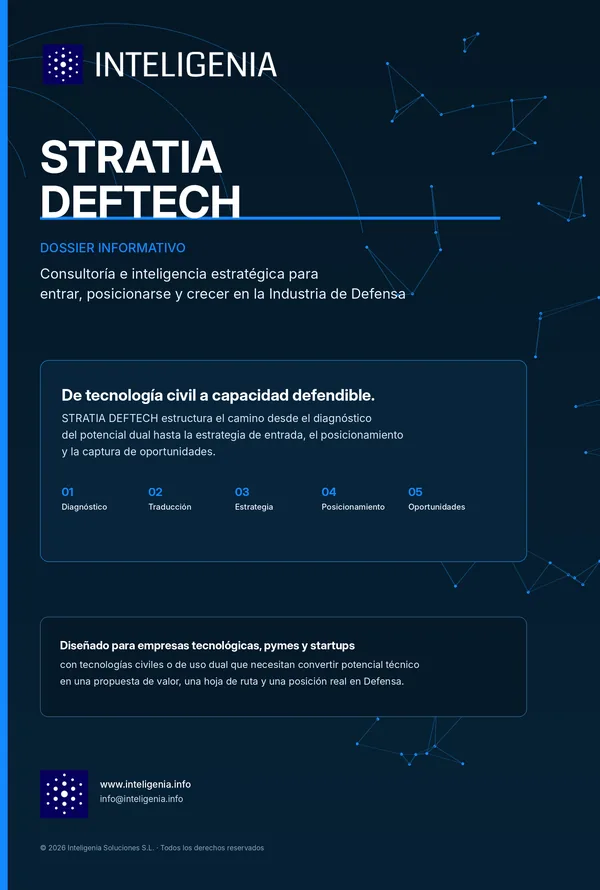
STRATIA DEFTECH
Consulting and strategic intelligence to enter, position yourself and grow in the Defence industry
From civil technology to a defensible capability.
STRATIA DEFTECH maps the path from diagnosing dual-use potential to entry strategy, positioning and opportunity capture.
- 01Diagnosis
- 02Translation
- 03Strategy
- 04Positioning
- 05Opportunities
01 · Value proposition
What STRATIA DEFTECH is
Entering Defence takes far more than finding a sales opportunity. It means understanding an ecosystem with its own rules, translating technology into the language of capabilities and building a coherent sequence of decisions.
STRATIA DEFTECH combines consulting and strategic intelligence to reduce uncertainty, prioritise efforts and sustain the company's position over time.
Our role
To prepare the company so that it has solid reasons to enter Defence: a clear proposition, a viable route to market and the intelligence it needs to act.
What makes this market different
A complex ecosystem
Defence bodies, the Armed Forces, major contractors, integrators and national, European and NATO programmes coexist with long decision cycles.
A demanding regulatory framework
Dual-use export controls, public procurement, security clearances, quality requirements and certifications all shape access.
Scattered information
Tenders, programmes, consortia, actors and windows of opportunity require continuous monitoring, analysis and prioritisation.
Specific risks
Protecting technology, know-how and sensitive information means building counter-intelligence and cyber intelligence into the strategy.
Our answer: intelligence applied to business decisions at every stage of market entry.
02 · Company profile
Who is it for?
Target companies
- Spanish technology companies.
- SMEs, start-ups and companies with dual-use products or technologies.
- Organisations that want to enter, position themselves or grow in Defence.
- Companies with mature civil solutions that need to identify applications and routes to market.
Areas with dual-use potential
- Cybersecurity and digital intelligence
- AI, analytics and synthetic data
- Drones, sensors and autonomous systems
- Communications, streaming and connectivity
- XR/VR/AR, simulation and digital twins
- Logistics, advanced materials and energy
- Operational healthcare and medical technology
- Digital platforms and support systems
When it adds most value
- 01
There is a civil technology or product with enough results and maturity to be recontextualised.
- 02
The company needs to decide which Defence capabilities it can cover and with what value proposition.
- 03
Management wants a realistic roadmap to access the ecosystem, prioritise contacts and activate opportunities.
03 · Methodology
The STRATIA DEFTECH method
- 01
DEFTECH diagnosis
We assess fit, maturity, risks, barriers to entry and dual-use potential.
Outcome: Decide whether there are solid reasons to enter.
- 02
Technology translation
We turn the civil solution into a Defence capability: mission, user, effect, integration and requirements.
Outcome: Build a value proposition the sector understands.
- 03
Entry strategy
We define the most viable route to market, the roadmap and the priorities.
Outcome: Turn potential into a sequence of decisions.
- 04
Positioning
We identify key actors, decision-makers, partners, integrators and ecosystems.
Outcome: Prepare the narrative and the relationship plan.
- 05
Opportunity capture
We activate monitoring and analysis to detect, filter and prepare specific opportunities.
Outcome: Focus resources where the fit is best.
The goal is not just to “be in Defence”, but to build a competitive reason for being there.
04 · Definition phase
DEFTECH diagnosis and technology translation
DEFTECH diagnosis
We analyse the company, the technology and the market to establish an objective basis for decisions.
- Fit with priority needs and capabilities.
- Technical maturity, demonstrability and scalability.
- Dual-use potential and indicative dual-use classification.
- Barriers to entry: procurement, quality, security, approvals and certifications.
- Initial map of relevant bodies, integrators, associations and ecosystems.
- Information risks, digital exposure and protection of know-how.
Typical deliverables: situation report, dual-use potential assessment, actor map and initial roadmap.
Technology translation
We reframe the civil solution in terms of use, mission, user and operational effect.
- Identifying realistic Defence use cases.
- Defining the operational user and the problem being solved.
- Translating features into capabilities and effects.
- Adaptation, integration, interoperability and deployment needs.
- Dual-use value proposition versus alternatives.
- Technical, regulatory and security requirements to build into the roadmap.
Working principle: when the core technology is already validated, we look to recontextualise it for Defence rather than reinvent it.
05 · Activation phase
Strategy, positioning and opportunities
Entry strategy
We design the most viable route to market according to maturity, sector and ambition.
- Direct route, via an integrator/prime or a consortium.
- National and European programmes.
- Certification and partnership roadmap.
- Positioning plan and priorities.
Positioning
We turn the ecosystem map into an agenda of relationships and messages.
- Priority actors and decision-makers.
- Technology and industrial partners.
- Preparation for meetings and trade fairs.
- Situation briefs and value narrative.
Opportunity capture
We activate continuous intelligence to detect, filter and prepare specific opportunities.
- Monitoring of tenders and programmes.
- Tactical alerts and analysis.
- Prioritisation by fit and probability.
- Support for programmes, consortia and projects.
Routes to market we assess
- Institutional client / pilot
- Prime or integrator
- Consortium / joint venture
- National or EU programme
- Ecosystem, cluster and industry forum
06 · From civil to Defence
Examples of technology translation
Immersive simulation, VR/AR and adaptive learning
Operational, medical or technical training; dynamic scenarios; multi-user instruction and performance assessment.
Low-latency streaming and multi-site experiences
Distributed training, remote briefings, cross-site collaboration and synchronised immersive experiences.
Digital twins and interactive 3D environments
Planning, mission rehearsal, infrastructure visualisation and command-and-control support.
Generative AI, modelling and synthetic content
Generating scenarios and synthetic data to train surveillance, sensor or autonomous-system algorithms.
Augmented reality and contextual overlays
Support for technical instruction, maintenance, procedures and contextual visualisation in complex environments.
Medical technology and digital health platforms
Operational healthcare, medical training, rehabilitation, psychological support and monitoring in military settings.
Criteria for assessing a translation
- A real need and an identifiable user.
- A demonstrable operational or economic advantage.
- Degree of adaptation versus development from scratch.
- Interoperability, security, data sovereignty and deployment.
- A validation, certification and procurement route compatible with the solution.
07 · Intelligence architecture
Intelligence on three levels
We anticipate spending trends and how capabilities, technologies and risks evolve. It helps decide where to position yourself and which bets to keep.
We turn the environment into actionable intelligence: programmes, tenders, key actors, potential partners and windows of opportunity.
We prepare execution: meetings, trade fairs, situation reports, event monitoring and context for immediate decisions.
Cross-cutting capabilities
Competitive intelligence
Monitoring of the market, competitors and potential partners.
Foresight analysis
Future scenarios for spending, programmes and technologies.
Situation reports
An accurate snapshot of the context for each decision.
Counter-intelligence
Protection of your own know-how, technology and information.
Cyber Intelligence
Monitoring of threats and digital exposure.
Tailored services
Bespoke solutions by sector, maturity and business goal.
08 · Deliverables and results
What your company receives
Possible deliverables
- Market situation report applied to your sector.
- Assessment of dual-use potential and use cases.
- Map of actors, decision-makers, partners and integrators.
- Entry and positioning roadmap.
- Strategic plan and partnership strategy.
- Tactical reports and opportunity alerts.
- Foresight analyses and scenarios.
- Briefing packs for meetings, events and key decisions.
- Counter-intelligence and cyber intelligence reports.
- In-company training on Defence culture, the ecosystem and information protection.
Results for the company
Identify real applications
Find where the technology adds value and where it does not.
Prepare the organisation
Understand requirements, barriers, certifications and risks before committing resources.
Improve positioning
Reach actors and integrators with a value narrative adapted to the ecosystem.
Prioritise opportunities
Separate signal from noise and focus effort on the windows with the best fit.
Turn technology into a competitive proposition
Reframe a civil or dual-use product as a useful Defence capability.
Protect your know-how
Build counter-intelligence and cyber intelligence measures into the entry process.
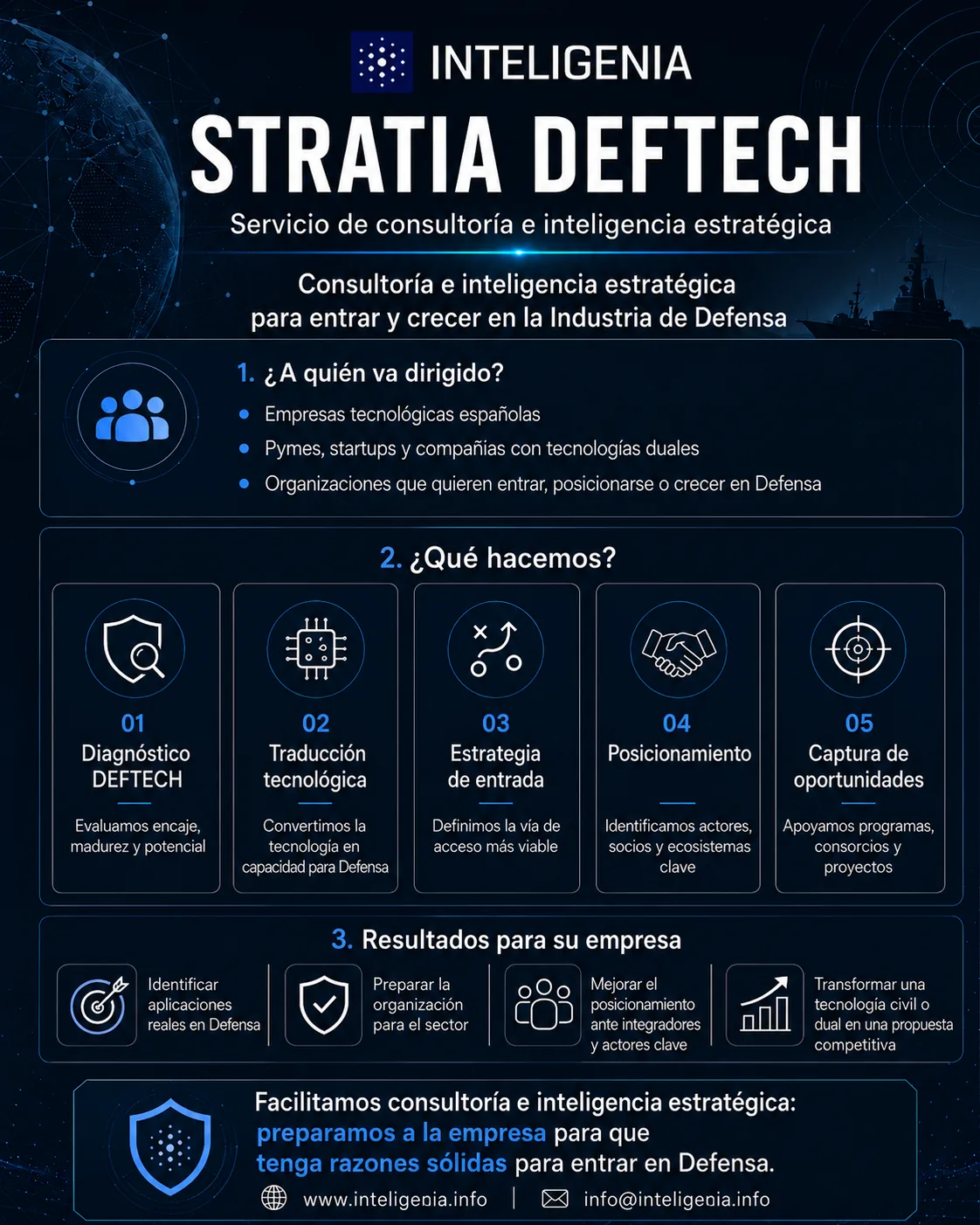
STRATIA DEFTECH at a glance
Service summary
Information brochure11 pages · PDF in Spanish · 0.4 MBDownload the brochure09 · Process and principles
How we work
Onboarding process
- 01
Initial meeting
We get to know the company, its technology, goals, maturity and main questions.
- 02
Scope definition
We define the intelligence questions, deliverables, priorities and way of working.
- 03
Agreement and NDA
We set the confidentiality framework, information handling and terms of collaboration.
- 04
Kick-off
We start the diagnosis and roadmap with contacts appointed by both parties.
Inteligenia's commitments
Sources and methods
Open sources (OSINT) and legal, ethical methods in all our work.
Confidentiality
An NDA from day one and careful handling of sensitive business information.
Conflicts of interest
Sector-level management of conflicts of interest to keep the service independent.
Regulatory guidance
Guidance on dual-use and procurement is informative only; formal legal advice and procedures are referred to specialists and the competent authorities.
10 · Next step
From technology to positioning
Intelligence to decide. Strategy to enter. Positioning to grow.
We can start with a conversation about your technology, its maturity and the questions you need answered before investing time and resources in the Defence market.
What we can look at in an initial conversation
- What Defence applications your technology could have.
- What level of adaptation, validation or certification it may require.
- Which actors, partners and integrators matter most.
- Which route to market looks most viable for your company.
- What information you need before taking the next decision.